Background
Recently, a customer of mine was in the process of house hunting and became interested in a designer-renovated single-family home. Homes like this are not uncommon in the Pasadena area. Many properties here date back several decades, and after thoughtful renovations, they often present a strong Mid-Century Modern aesthetic, which naturally attracts buyers who value distinctive architectural character.
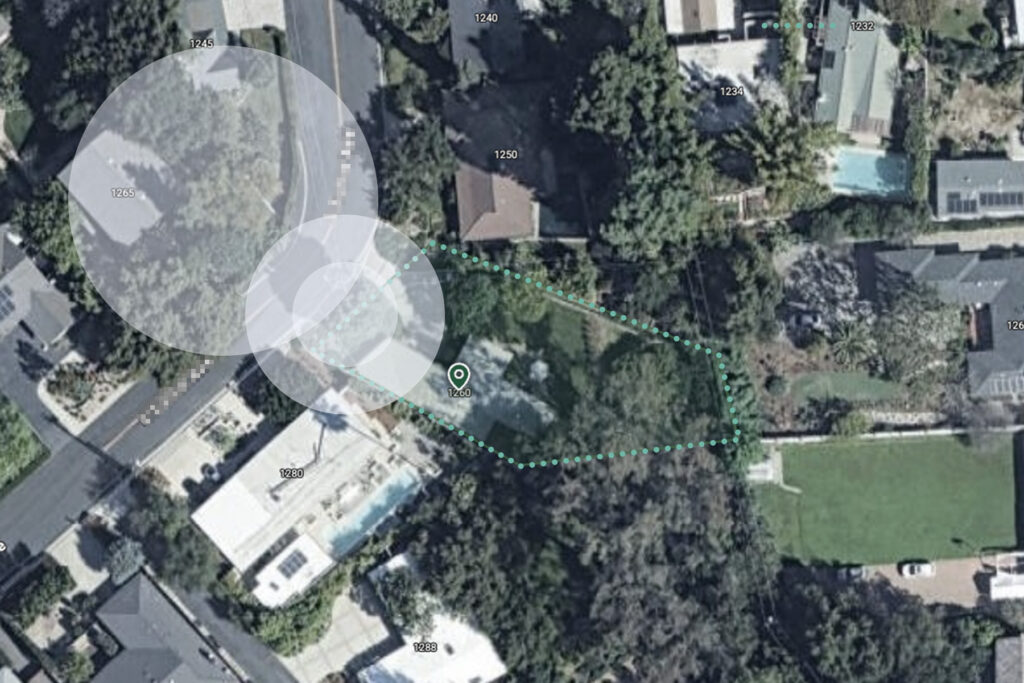
My customer shared the listing information along with photos taken during the showing, and asked me to review the property from a feng shui and environmental layout perspective. After studying the images and satellite maps, I noticed a classic but often underestimated issue in feng shui practice: overlapping adverse conditions, known as “stacked formations.”
The Core Issue: What Are “Stacked Formations”?
In feng shui, stacked formations refer to multiple unfavorable landforms or environmental pressures accumulating within the same directional sector or spatial area.
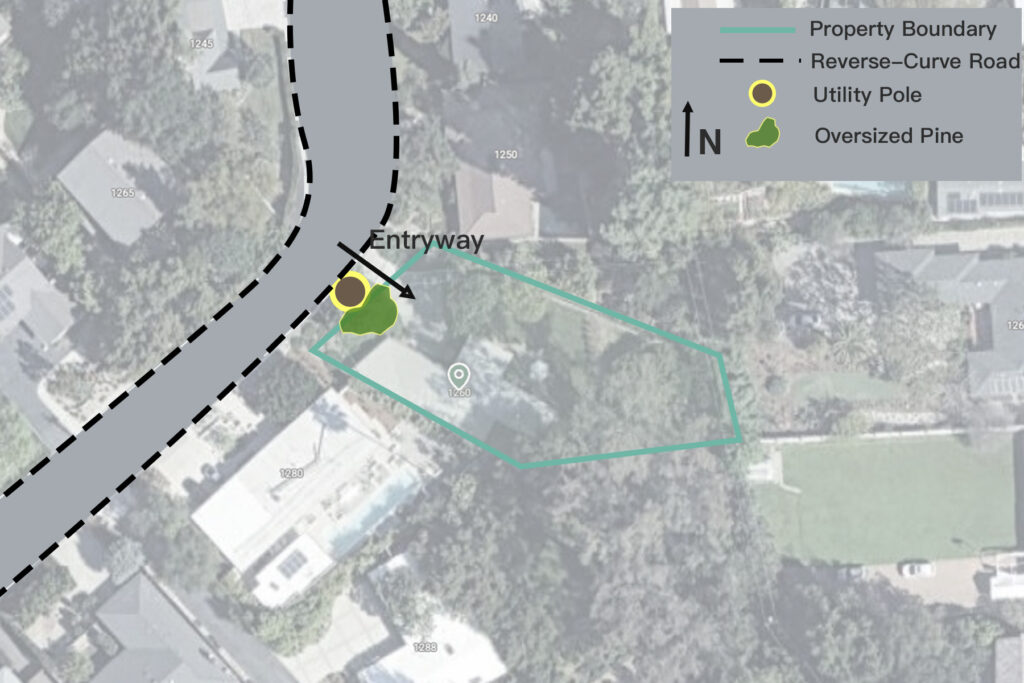
In this case, the primary stacked condition is concentrated in the Northwest (Qian sector)—specifically within the front-yard and street-facing zone of the house. Several factors that might be manageable on their own are layered within the same area, significantly increasing their combined impact.
This type of accumulation tends to create persistent directional pressure, making issues associated with that sector more likely to surface over time.
Northwest (Front Yard):
1. Reverse-Curve Road (Front Exposure)
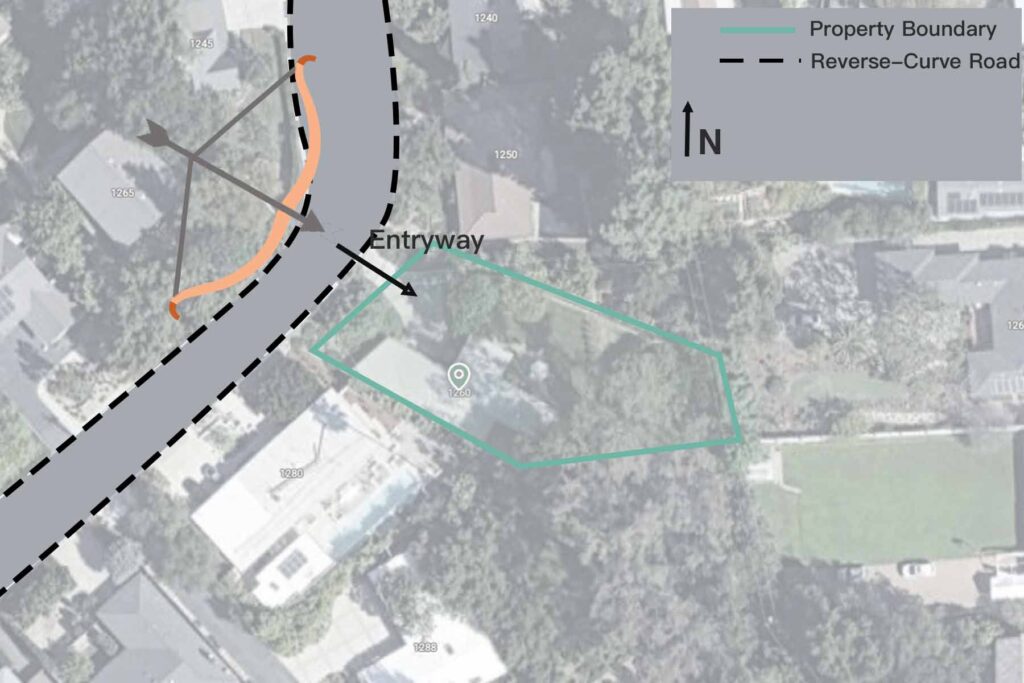
In front of the house, toward the northwest, the road forms a reverse curve—a situation where traffic flows away from the property rather than gently embracing it. The road connects closely with a main street and carries a noticeable volume of vehicles.
From a feng shui standpoint, this creates continuous outward pressure, especially when the house sits at the focal point of the curve. The effect is not dramatic in isolation, but long-term exposure often correlates with resistance in career progress or increased external obstacles.
Because the northwest and front-facing area correspond to the Ming Tang (Phoenix position)—a concept traditionally associated with visibility, opportunity, and external support (explained in more detail in my article on the Four Celestial Animals in feng shui)—prolonged exposure to this condition may show up as:
- Career advancement feeling blocked or delayed
- Increased stress from external forces
- Pressure-related health concerns (mental strain, head, or cardiovascular stress)
2. Utility Pole at the Impact Point (Direct Line Pressure)
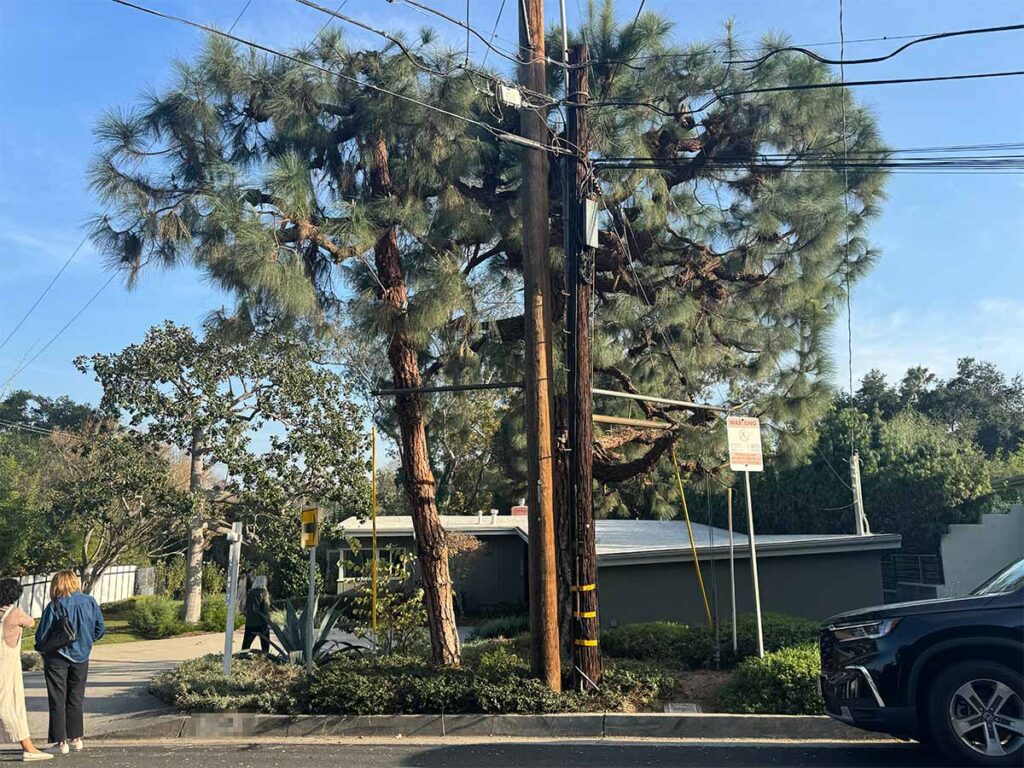
The street uses an above-ground power system, with utility poles placed at regular intervals along the road. On their own, these poles would usually be considered a shared neighborhood feature and not overly problematic.
However, in this case, one pole sits precisely at the focal point of the curved road’s impact, creating a strong directional visual and energetic line aimed at the house. This alignment intensifies the sense of pressure, making the front exposure feel more targeted and less diffuse.
3. Oversized Pine Trees (Visual and Spatial Suppression)
Additionally, there are tall pine trees near the front of the house. As evergreen species, pine and cypress trees carry significant visual mass year-round and can easily dominate a residential frontage if not carefully scaled.
When planted close to a house, these trees require regular pruning and proportion control. In this case, their height and density have grown out of balance with the building, creating a strong sense of visual compression and enclosure.
From an environmental and psychological perspective, this can:
- Reduce openness and long-range visibility
- Reinforce a feeling of pressure or containment
- Subtly weaken the sense of forward orientation and progression
East (Backyard):
Deep Land Depression and Weakened Support
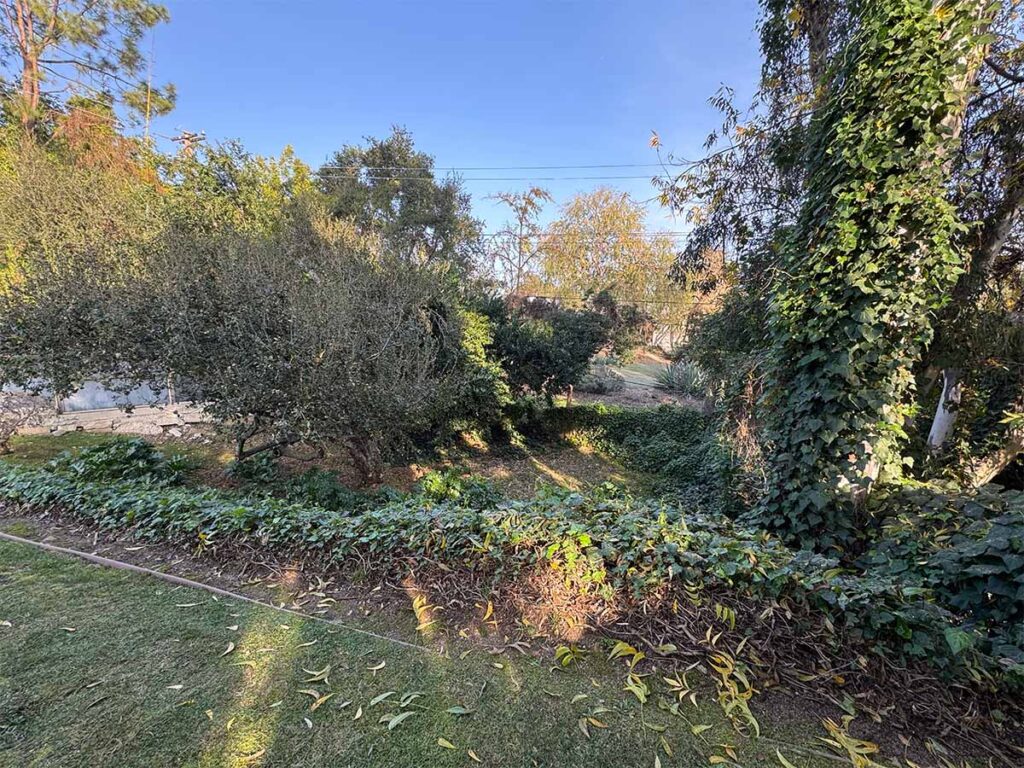
In addition to the stacked conditions identified at the front of the property, there is a separate site-related issue at the rear.
At the back of the house, in the eastern sector, the land drops sharply into a depression approximately three meters deep. From a form-based feng shui perspective, the backyard corresponds to the Black Tortoise position—the rear support zone within the Four Celestial Animals framework (explained in more detail in my article on the Four Celestial Animals in feng shui). This position represents structural support, stability, and long-term grounding. Ideally, it should be gently elevated or at least level, providing a calm and reliable sense of backing.
The eastern sector (Zhen) is traditionally associated with growth, initiative, and forward movement. In residential analysis, conditions affecting this area often relate to sustained energy, learning capacity, and the ability to maintain momentum over time.
When a deep depression appears in this zone, it may correlate with:
- Persistent fatigue or difficulty sustaining effort
- Interrupted progress in work or study
- Heightened sensitivity to stress or emotional fluctuation
From a practical standpoint, this condition is best addressed through land leveling, terracing, or structural reinforcement, in order to restore a sense of backing, containment, and long-term stability.
Final Observation
What makes this property noteworthy is not any single flaw, but the stacking of multiple pressures within a limited area. Front-side resistance combined with weakened rear support creates a condition that may feel subtle at first, but tends to become more apparent over time.
Feng shui analysis ultimately focuses on degree, accumulation, and context—and this case illustrates why a comprehensive, site-based evaluation matters.