I’m often asked the same question:
In the same community, with nearly identical floor plans, why do some households thrive while others never quite feel settled?
In feng shui, we don’t only evaluate direction and layout. There’s also a time axis, a way of thinking that treats time as part of the environment. What people casually call “feng shui changes over time” is often discussed through a traditional framework known as San Yuan Jiu Yun (Three Cycles, Nine Periods). When the period changes, the priorities for home selection and layout strategy can shift as well.
San Yuan Jiu Yun in one paragraph
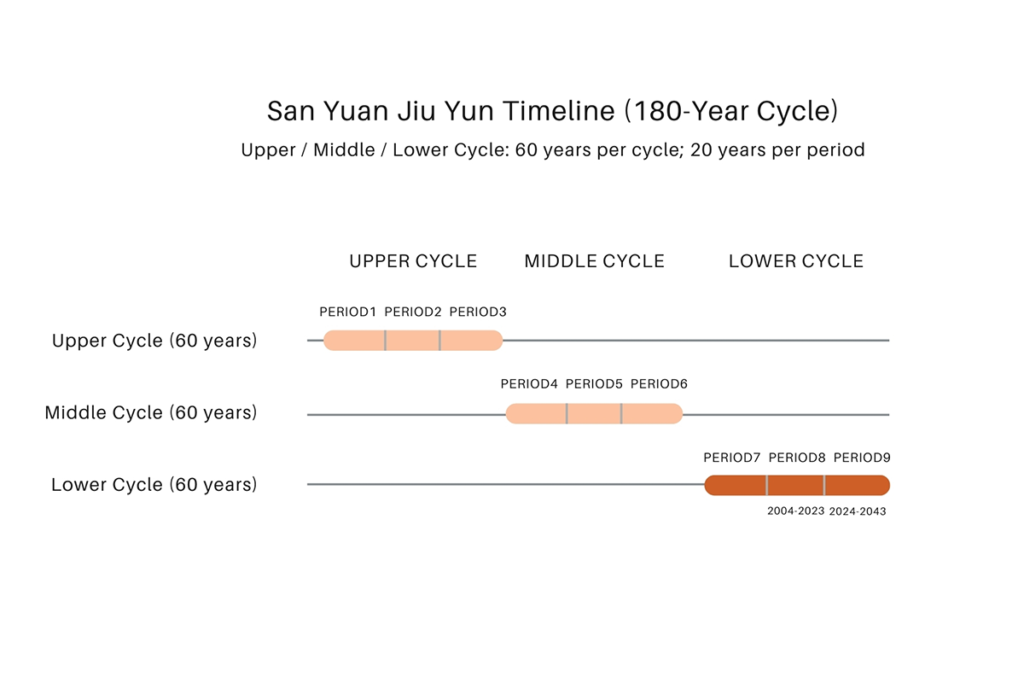
Traditionally, 180 years form one full cycle. That cycle is divided into three 60-year cycles, and each 60-year cycle is further divided into three 20-year periods, making nine periods in total. We are now in Period 9 (2024–2043), so Period 9 becomes the time background many practitioners use when reading a property.
A quick look back: Period 8 vs. Period 9
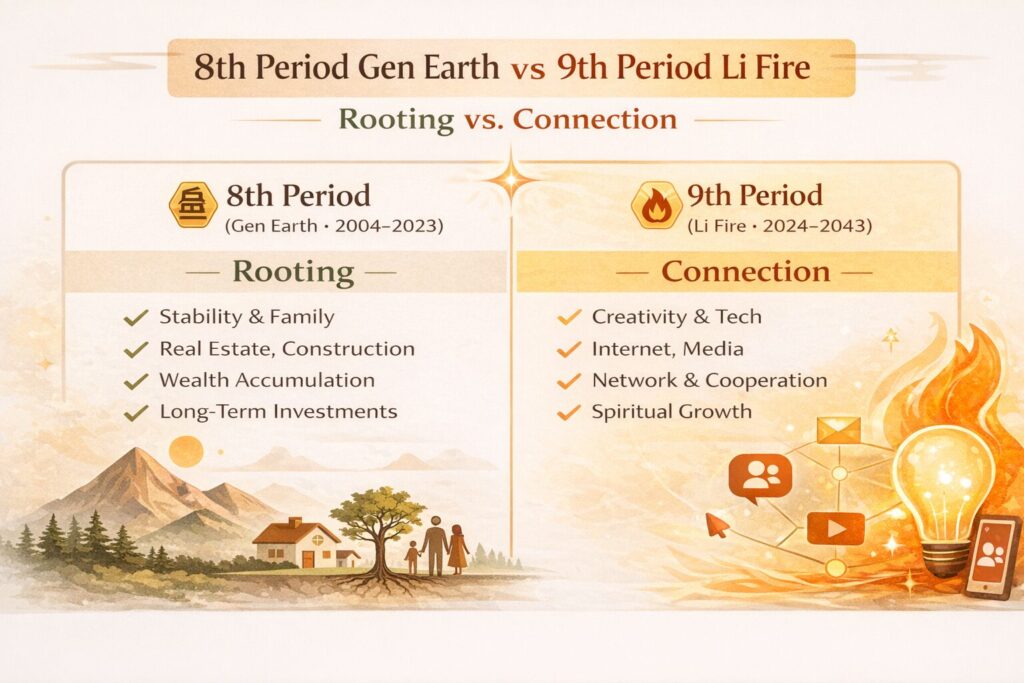
The previous period, Period 8 (2004–2023), is commonly associated with an “Earth / Mountain” tone, often interpreted as stability, accumulation, and rooting.
Period 9, by contrast, is associated with Li (Fire)—often interpreted as visibility, connection, and movement in modern life. (Think: attention, networks, circulation, how things connect and flow.)
The core Period 9 principle: Mountain vs. Water
In Xuan Kong (Flying Star) feng shui, you’ll often hear a Period 9 guideline expressed as:
“Zheng Shen to the mountain; Ling Shen to the water.”
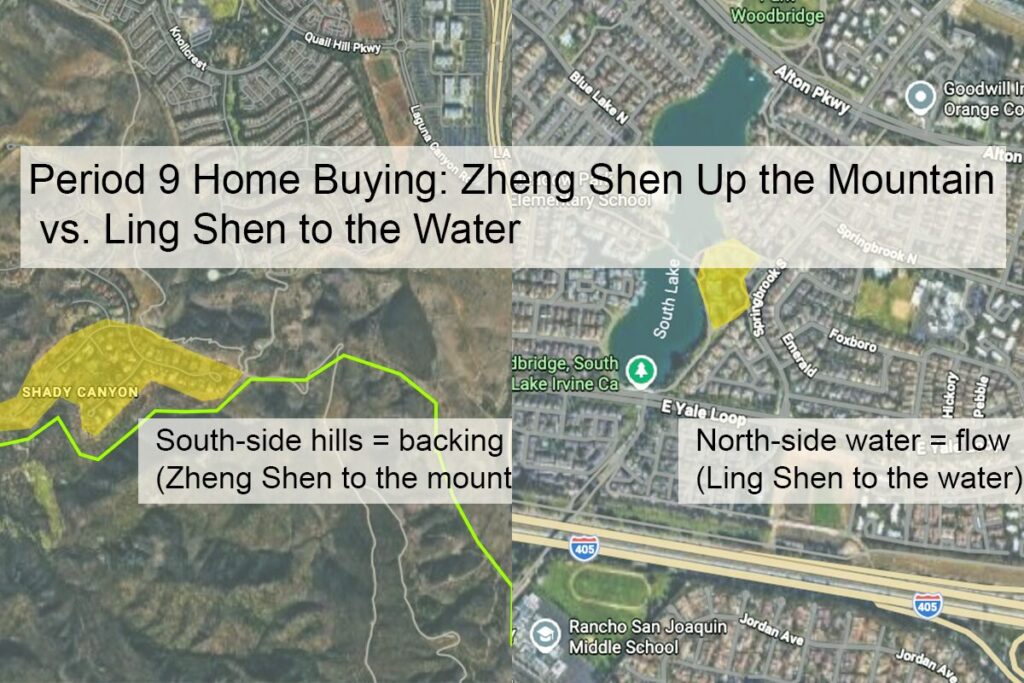
In plain English, it’s a practical rule of thumb about what tends to feel most supportive in Period 9, using the home as the reference point. In this period, the south side of the home (Li / Fire sector) is often treated as the Zheng Shen side, so having backing there (hills, higher ground, a solid built form, or a sense of support) is considered more aligned with receiving the period’s “prosperous qi.” Meanwhile, the north side (Kan / Water sector) is often treated as the Ling Shen side, so having water or movement there (a lake, or a river is traditionally viewed as more favorable for capturing wealth flow and opportunities.
Two Irvine communities that make this easy to see (macro level)
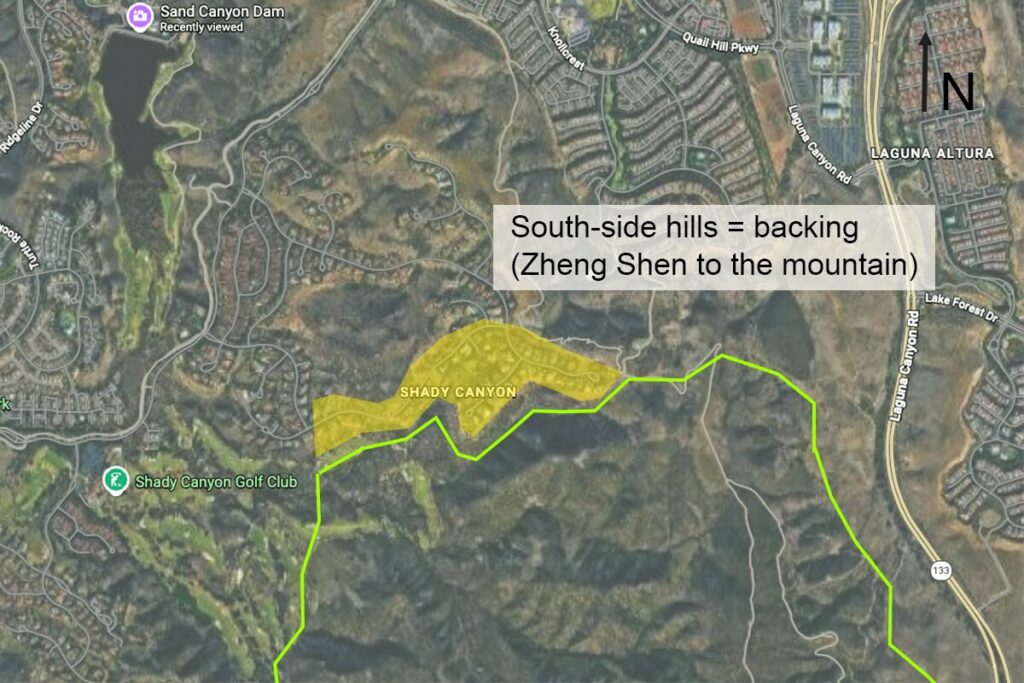
Shady Canyon has strong natural hills and mountain terrain to the south. From a landform perspective, homes in the southern portion can feel more “backed” and grounded—often described as an easier setup for stability in Period 9.
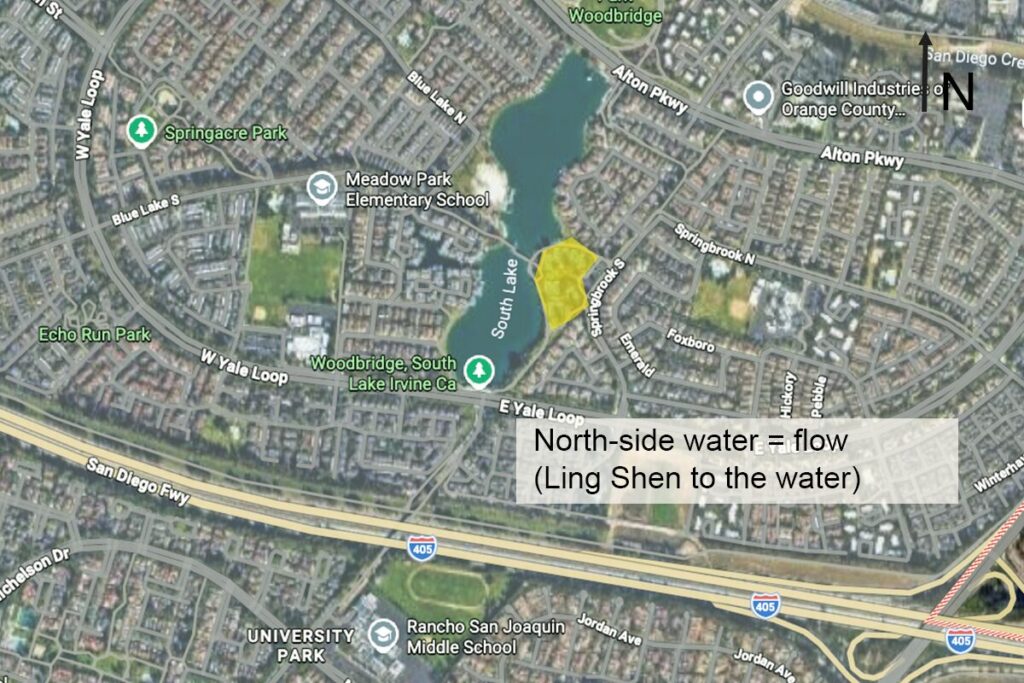
Woodbridge is organized around a major lake system, with significant water presence to the north. Homes on the south side of the lake can more naturally “receive” that water influence—often discussed as a pattern that supports flow, circulation, and connection.
A professional note: real feng shui needs real details
Everything above is a macro example. For a real property decision, we still need to check the exact orientation, surrounding roads, specific landform shape, and the interior layout. In other words: feng shui isn’t one rule—it’s a whole system.
If you’re looking at a property in Los Angeles, Irvine, or Newport Beach, you can send me the address and I’ll do a free Period 9 external-form quick check.
(Your address will be used only for feng shui evaluation and kept private.)