
In the West, Feng Shui is often filtered through a lens of mystique and consumerism. It arrives as a collection of “lucky” objects—three-legged frogs, red envelopes, mandarin ducks—that promise instant wealth and romance. For the rational, design-conscious mind, this portrayal is understandably hard to embrace. It feels like superstition, a departure from the grounded principles of architecture and psychology we trust to shape our living spaces.
But what if this popular version of Feng Shui is a profound misinterpretation? As a planner and scholar who has spent years studying the relationship between people and their environments, I see Feng Shui not as a set of magical beliefs but as a sophisticated, ancient system of environmental design. It is a practical wisdom rooted in observing how the natural world—its mountains, rivers, light, and air—influences human well-being. This article aims to peel back the layers of myth and present Feng Shui as it was originally intended: a rational, human-centered framework for creating harmony between ourselves and the spaces we inhabit.
Feng Shui as an Energy System: The Real Meaning of “Qi”
At the heart of Feng Shui is the concept of qi (pronounced “chee”). Often translated as “life force” or “energy,” qi is not a mystical or supernatural power. It is simply the dynamic, flowing quality of the universe, present in everything from the grand sweep of a mountain range to the subtle air currents in a room. Feng Shui divides this energy into two categories: the visible and the invisible.
Visible Energy: Mountains, Water, and Urban Form
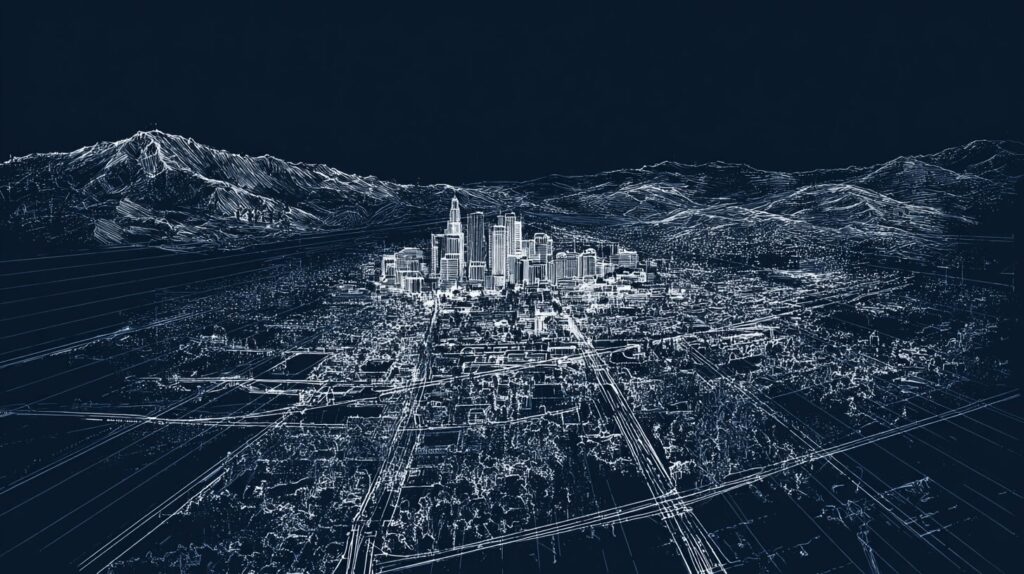
Visible qi is the tangible energy expressed in the physical forms around us. Ancient practitioners studied the shapes of mountains, the flow of rivers, and the contours of the land. They understood that these features were not inert backdrops but active forces that directed wind, gathered water, and influenced the feeling of a place. A gently curving river was seen as auspicious because it represented a smooth, nourishing flow of energy. A jagged, rocky mountain was considered less ideal because its sharp forms suggested instability.
In a modern urban context, these natural forms are replaced by buildings, roads, and infrastructure. The towering skyscraper becomes the mountain; the busy street becomes the river. The principles remain the same. The layout of a city grid, the width of a sidewalk, and the height of a building all shape the “visible qi” of a neighborhood, influencing how we feel and interact within that space. This is not magic; it is the fundamental language of urban planning and environmental design.
Invisible Energy: Ambient Fields and Universal Flow
Invisible qi refers to the ambient, unseen forces that permeate our environment. Think of it like the air we breathe or the subtle geomagnetic fields that guide migratory birds. We cannot see them, but their effects are undeniable. Feng Shui proposes that our homes and bodies are constantly interacting with these invisible energies.
This is not a call to believe in spirits or otherworldly forces. Instead, it is an acknowledgment that our environment is filled with subtle influences—sound waves, temperature variations, air quality, and even the quality of natural light. A room that feels “off” might be subject to low-frequency vibrations from a nearby highway or have stagnant air due to poor ventilation. Feng Shui provides a vocabulary to identify and harmonize these unseen but deeply felt environmental factors.
Human–Environment Relationship (Tian–Ren–He–Yi)

Crucially, Feng Shui is not about the objects or the space in isolation; it is about the relationship between the person and their environment. This is captured in the classical concept of Tian–Ren–He–Yi, or the “Oneness of Heaven, Human, and Earth.” An empty house has no Feng Shui. Its energy only becomes active and meaningful when a person lives in it, interacting with the space through their unique life patterns, habits, and perceptions.
Your home is a dynamic partner in your life, not a static container. It responds to your presence, and you, in turn, are influenced by its layout, light, and flow. This symbiotic relationship is the true focus of authentic Feng Shui practice.
What Feng Shui Is Not (Debunking Myths)
To appreciate what Feng Shui truly is, we must first clear away the common misconceptions. Many popular ideas surrounding the practice are distortions that obscure its practical and psychological foundations.
Myth 1: Feng Shui Can Make You Rich Overnight
One of the most persistent feng shui myths is that it is a secret key to instant wealth. While a harmonious environment can certainly support your focus, reduce stress, and improve your overall capacity for success, it is not a magical formula for winning the lottery. Real Feng Shui works gradually, subtly shifting the energetic patterns of your life to foster stability and opportunity. It creates the fertile ground where your efforts can flourish, but it does not do the work for you.
Myth 2: Feng Shui Is Religious or Magical
Feng Shui is not a religion, a dogma, or a belief system. You do not need to “believe” in it for its principles to work, just as you do not need to “believe” in gravity for an apple to fall. It is an observational science, a framework for understanding how spatial arrangements and environmental factors impact human experience. Its wisdom is available to anyone, regardless of their spiritual or religious background.
Myth 3: Feng Shui = Lucky Objects
The commercialization of Feng Shui has led to the belief that it is about placing specific trinkets—like waving cats, money frogs, or bamboo flutes—in your home. These objects are cultural symbols and have little to do with the core principles of classical Feng Shui. Authentic practice focuses on foundational elements: the orientation of your home, the layout of your rooms, the flow of movement, and the balance of natural elements like light and air. It is about spatial organization, not decoration.
How Feng Shui Actually Works
The effectiveness of Feng Shui can be understood through the modern lenses of psychology, environmental design, and urban planning. Its ancient wisdom aligns remarkably well with contemporary scientific insights into how our surroundings affect our minds and bodies.
Command Position & Perceived Control (Psychological Safety)
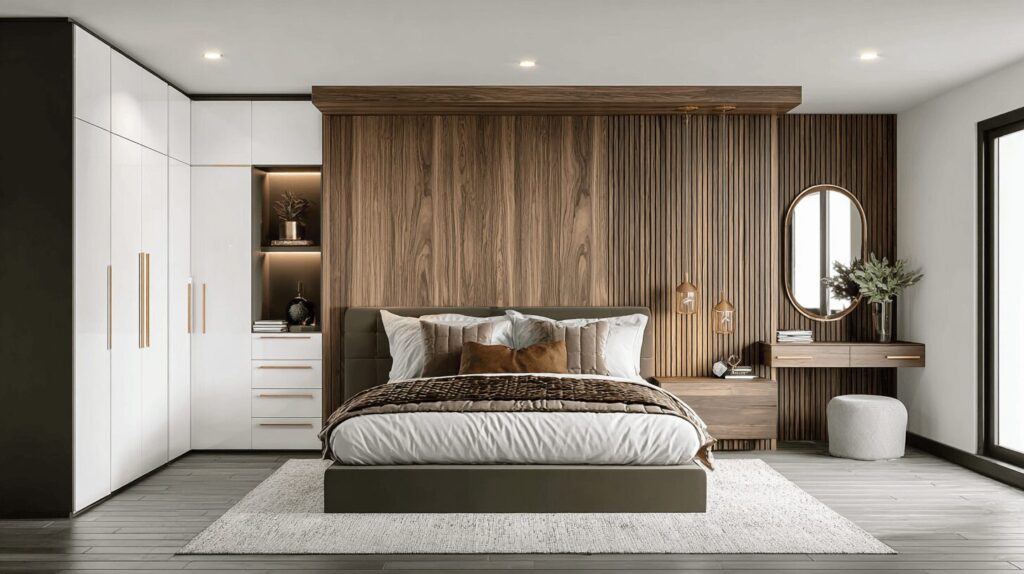
A core Feng Shui principle is the “command position,” which advises placing your bed, desk, or stove in a location where you have a clear view of the door without being directly in its path. Psychologically, this is about perceived control and safety. When you can see who is entering your space, your nervous system can relax. Your subconscious is not on high alert for potential threats from behind. Having a solid wall behind you (a “mountain”) offers a sense of support and stability, further reducing subconscious stress and freeing up mental energy for rest or focus.
Roads, Energy Flow & Urban Circulation (Urban Planning Analogy)
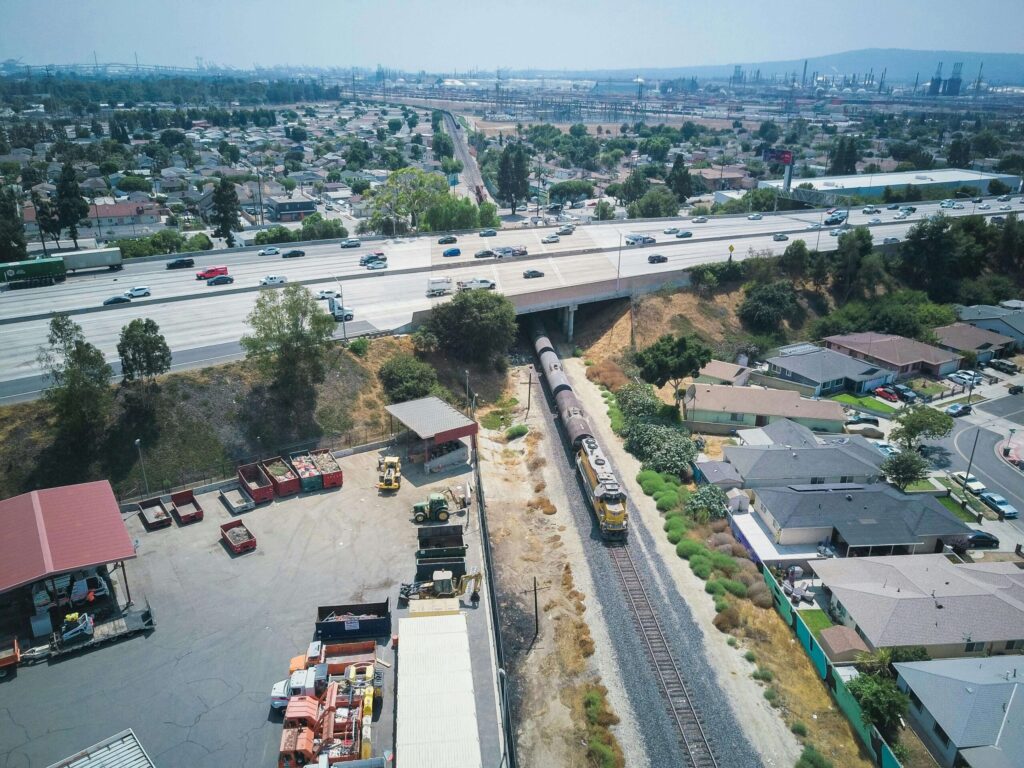
As a planner, I see a powerful parallel between Feng Shui’s concept of qi flow and the principles of urban circulation. Think of the roads around your home as arteries carrying energy. A house at the end of a long, straight road is said to experience “sha qi” or harsh energy, similar to how a home at the end of a freeway off-ramp endures the constant pressure of fast-moving traffic, noise, and light pollution. Conversely, a home on a gently curving street with slower traffic feels more peaceful and protected. This isn’t mystical; it’s a tangible assessment of how urban design impacts the sensory experience of a home.
Unstable Energy & Sensory Load (Environmental Psychology)
Feng Shui often advises against sleeping in a room situated above a garage. This is traditionally explained as being exposed to “unstable qi.” From an environmental psychology perspective, this makes perfect sense. A garage is a space of movement, noise, and chemical smells from vehicles. Even if subtle, the vibrations from the garage door opening and closing, the engine starting, or the faint scent of gasoline can create a low-level sensory load that disrupts deep, restorative sleep. The mind registers this instability, even if we are not consciously aware of it.
Feng Shui in Southern California Homes (Author’s Real Observations)
The principles of Feng Shui are universal, but their application is specific to the local environment. Here in Southern California, the unique topography and architectural styles create distinct energetic patterns.
Irvine — Narrow Backyards & Lack of Backing
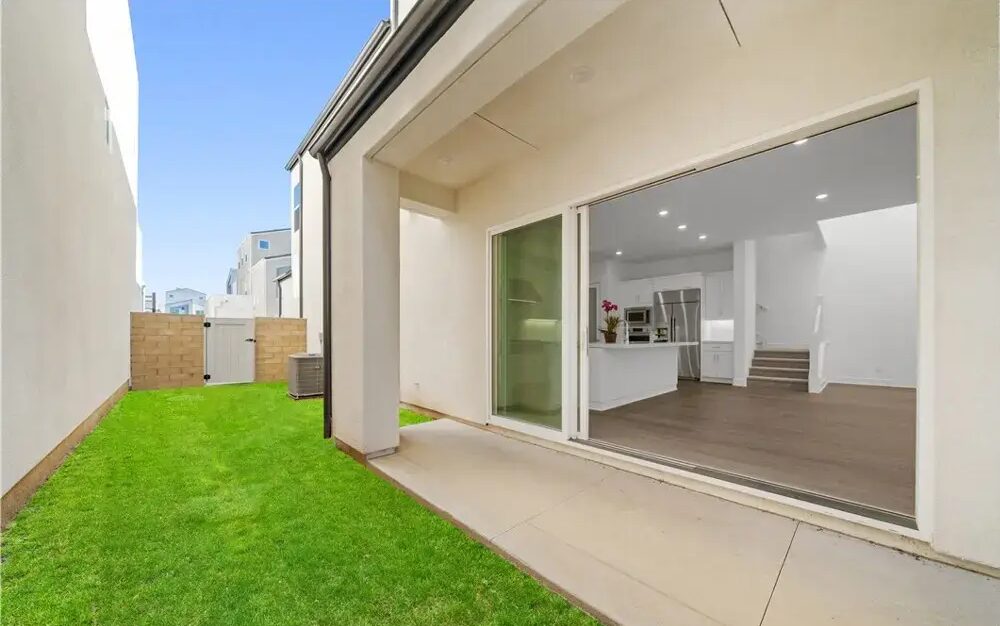
Many newer housing developments in areas like Irvine are built for density. This often results in homes with very narrow backyards, sometimes backing directly onto a neighbor’s wall or a busy street. In Feng Shui, the backyard represents the “Black Tortoise,” the source of support and stability. When this space is compressed or non-existent, it can create a subconscious feeling of being crowded, unsupported, or vulnerable. The lack of a “supporting mountain” can leave residents feeling exposed.
Chino Hills — Gentle Slopes & Stable Energy
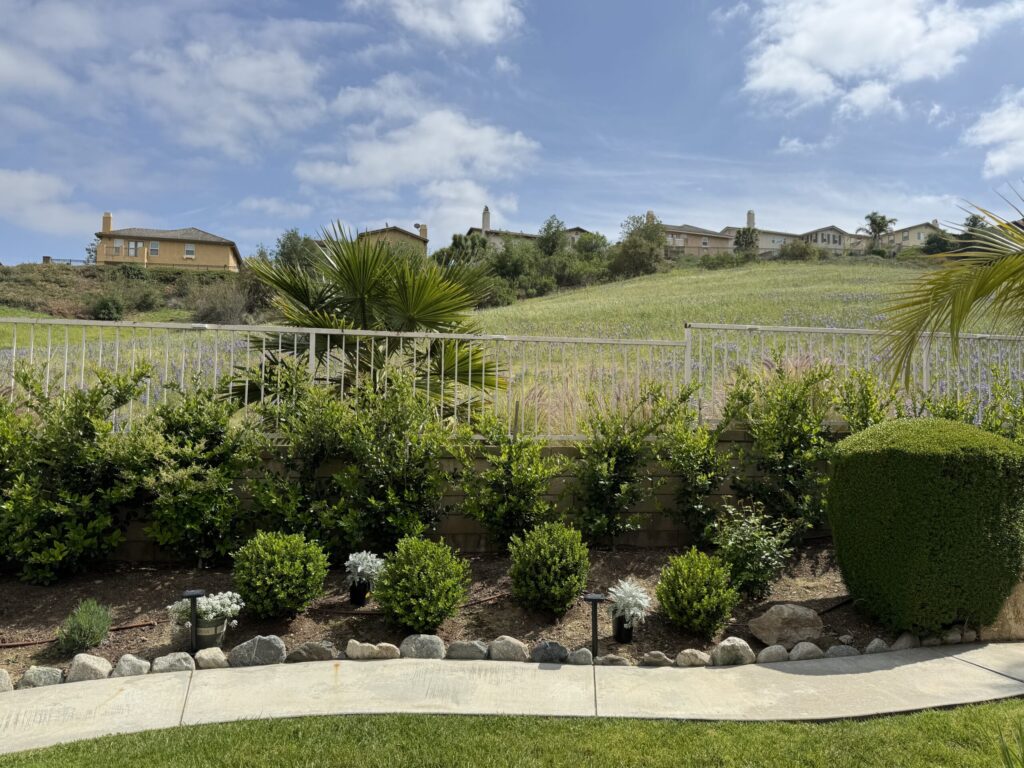
In contrast, many homes in Chino Hills are nestled among rolling landscapes, often near the state park. These properties frequently sit on gentle slopes, with the home positioned in a way that is embraced by the landform. This natural armchair-like configuration is considered highly auspicious in Feng Shui, as it allows qi to gather and settle. The result is a feeling of being grounded, protected, and stable—an experience that residents often describe without knowing the underlying Feng Shui principles.
Pasadena — Vintage Homes, Sharp Corners & Steep Hills
Pasadena’s beautiful vintage homes present their own set of challenges. Older layouts can be complex, with sharp corners (“poison arrows”) or long, narrow hallways that cause energy to accelerate and become unsettling. Furthermore, many homes are built on steep hillsides. A home perched precariously on a slope without a solid, level foundation can create a sense of instability, while a home at the bottom of a steep hill may feel oppressed by the downward pressure of the landform.
Most Common Reader Questions (Q&A Section)
Does Feng Shui really work?
Yes, but not in the magical way it is often portrayed. It works by optimizing your environment to better support your psychological and physiological well-being. By improving spatial arrangements and reducing subconscious stressors, it helps create an environment where you can feel more relaxed, focused, and resilient.
How do I know if my home has good Feng Shui?
Pay attention to how you feel. Does your home feel supportive, calm, and uplifting? Or do you feel drained, restless, or “stuck”? A home with good Feng Shui generally has abundant natural light, clear pathways for movement, a sense of order, and a strong connection to the outdoors. It should feel like a sanctuary that recharges you.
Where does Feng Shui come from?
Feng Shui, which translates to “wind and water,” originated over 3,000 years ago from ancient Chinese observations of the cosmos. Its earliest practitioners were astronomers who meticulously charted the movements of stars, celestial patterns, the 28 lunar mansions, and the Four Symbols—the Azure Dragon, White Tiger, Vermilion Bird, and Black Tortoise. These star patterns served as symbolic models of cosmic order. Guided by the philosophical principle of Tian-Ren-He-Yi (the unity of Heaven, Humanity, and Earth), these celestial principles were mapped onto the terrestrial landscape. This system of connecting cosmic order with natural landforms was later applied to determine auspicious locations for tombs, and eventually for homes and cities, creating harmony between the heavens, the earth, and human life.
Is Feng Shui compatible with modern interior design?
Absolutely. In fact, good Feng Shui and good design are often one and the same. Both prioritize flow, balance, light, and functionality. You do not need to fill your home with Asian-style decor. The principles can be applied to any aesthetic, from minimalist to mid-century modern, to create a space that is both beautiful and energetically supportive.
A Practical, Human-Centered Way to Live Better

Feng Shui is not about superstition, lucky charms, or rigid rules. At its core, it is a profound and practical form of wisdom. It teaches us to see our homes not as collections of objects, but as living, breathing systems that have a direct impact on our quality of life.
As someone who has lived and worked in Southern California, and observed how people respond to their homes, I’ve come to believe that Feng Shui offers a timeless language for understanding our relationship with space.